Dice Puzzle – Addictive Number Merge Game
There is something deeply satisfying about watching three dice with the same number touch and magically transform into a single, higher-value die. It feels like a small victory. And when you chain multiple merges together, clearing half the board in one move? That feeling is pure euphoria.
Dice Puzzle, developed by Playgama, takes the classic merge mechanic and adds clever twists: dice appear solo or in connected pairs, you can rotate them before placing, and matches count not just in straight lines but also diagonally. The result is a puzzle game that is easy to learn, surprisingly deep, and endlessly replayable.
This comprehensive guide covers everything you need to know about Dice Puzzle: how to play, advanced strategies, scoring mechanics, and why this game has become a favorite among fans of number puzzles and merge games worldwide.
What Is Dice Puzzle? An Overview
Dice Puzzle is a merge puzzle game where players place numbered dice onto a grid. The core objective is simple: combine three or more dice with the same number to merge them into a single die of the next higher value. For example, three dice showing the number 1 merge into one die showing 2. Three 2s merge into a 3, and so on.
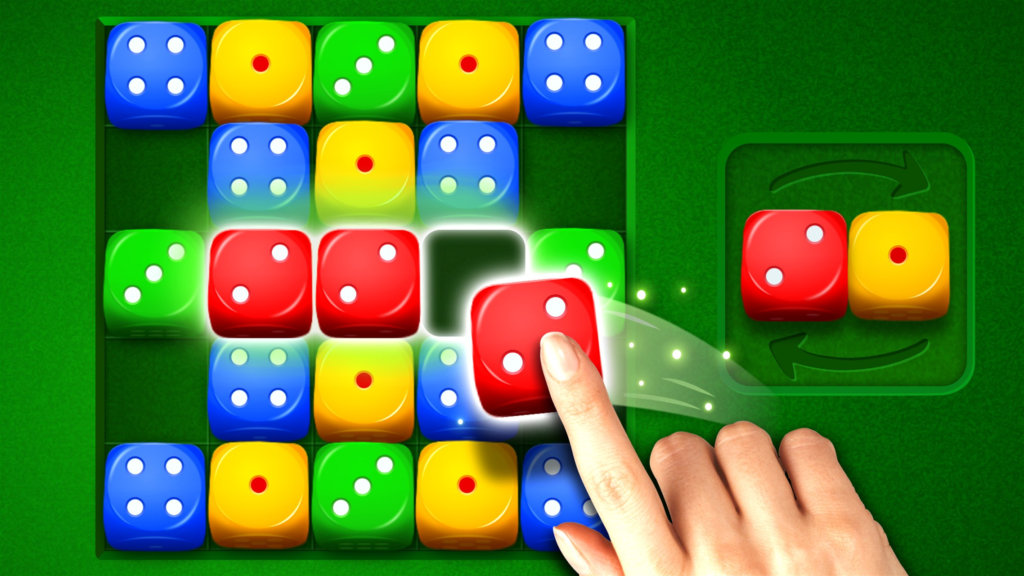
The game provides a tray containing dice—sometimes individual dice, sometimes pairs of dice connected together. You drag these dice onto the grid, position them carefully, and watch as matches trigger automatically. You can rotate pairs before placing them, giving you more control over how they fit.
What makes Dice Puzzle unique is its diagonal merge rule. Unlike many merge games that only count horizontal and vertical connections, Dice Puzzle also counts dice that touch diagonally (corner to corner). This expands your merging options significantly and rewards creative placement strategies.
The game ends when you run out of space to place new dice. There is no time limit, no move limit, and no penalty for taking your time. You can stare at the grid for as long as you like, planning your next move.
Why Dice Puzzle stands out:
- Diagonal merging – More ways to combine than typical match games
- Rotatable dice pairs – Strategic placement options for connected dice
- Storage slots – Save dice for later use when timing matters
- Chain merges – One placement can trigger multiple consecutive merges
- Endless gameplay – No levels, just increasingly challenging board management
- Play anywhere – Browser-based with no download required
How to Play Dice Puzzle: Core Mechanics
The Playing Grid
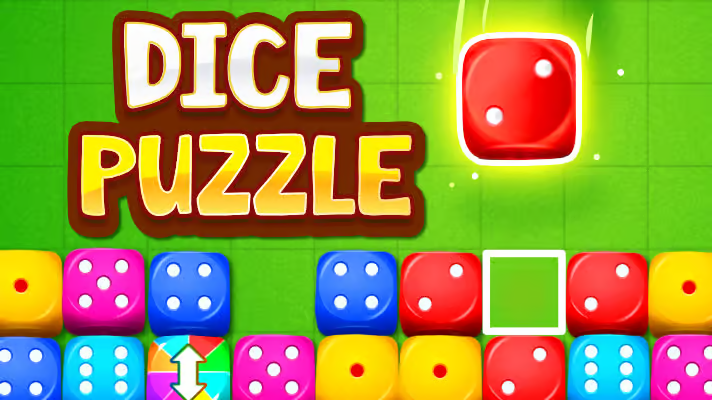
You are presented with a grid—typically 5×5 or 6×6 cells, depending on the version. This is your playing field. Each cell can hold one die. You will fill this grid gradually, merging dice to clear space and make room for more.
The Dice Tray
Below or beside the grid, you see a tray containing dice. The tray usually holds three dice (or dice pairs). When you place one, a new die appears to replace it. Some versions also show upcoming dice so you can plan ahead.
Dice appear in two forms:
- Single die – A standard cube showing a number (typically starting at 1, but higher numbers appear after merges)
- Pair of dice – Two dice connected together in a specific shape (side-by-side, L-shape, etc.)
Placing Dice
To place a die or pair:
- Select the die/pair from the tray (click or tap)
- Rotate if needed (tap the die in the tray; it rotates 90 degrees each time)
- Drag it onto an empty space on the grid
- Release to place it
Once placed, a die cannot be moved. Choose your placement carefully—there is no undo button.
Rotating Pairs
Rotation is a critical feature for pairs. A horizontal 2×1 pair (two dice side by side) can be rotated into a vertical 2×1 pair (two dice stacked). An L-shaped pair can be rotated into four different orientations. Always check if rotating makes a pair fit better before placing.
Merging Rules
When three or more dice with the same number are connected (touching), they automatically merge into a single die of the next higher number.
What counts as “connected”:
- Horizontally – Dice next to each other in the same row
- Vertically – Dice next to each other in the same column
- Diagonally – Dice touching at corners
This diagonal rule is what makes Dice Puzzle special. In most merge games, only horizontal and vertical lines count. Here, an L-shape, a zigzag, or even a cluster can trigger a merge.
Merge examples:
- Three 1s touching → merge into one 2
- Four 2s touching → merge into one 3 (and possibly leave a leftover 2, depending on the exact configuration)
- Five 3s in a cross pattern → merge into one 4
Chain Merges
This is where the game gets exciting. When dice merge, they disappear from their positions, and a new die appears where one of them was. That new die might then connect with other dice of the same value, triggering another merge immediately.
A single placement can cause a chain reaction of 2, 3, or even more merges. Chain merges are the key to high scores because they clear multiple dice with one move and often create higher-value dice faster.
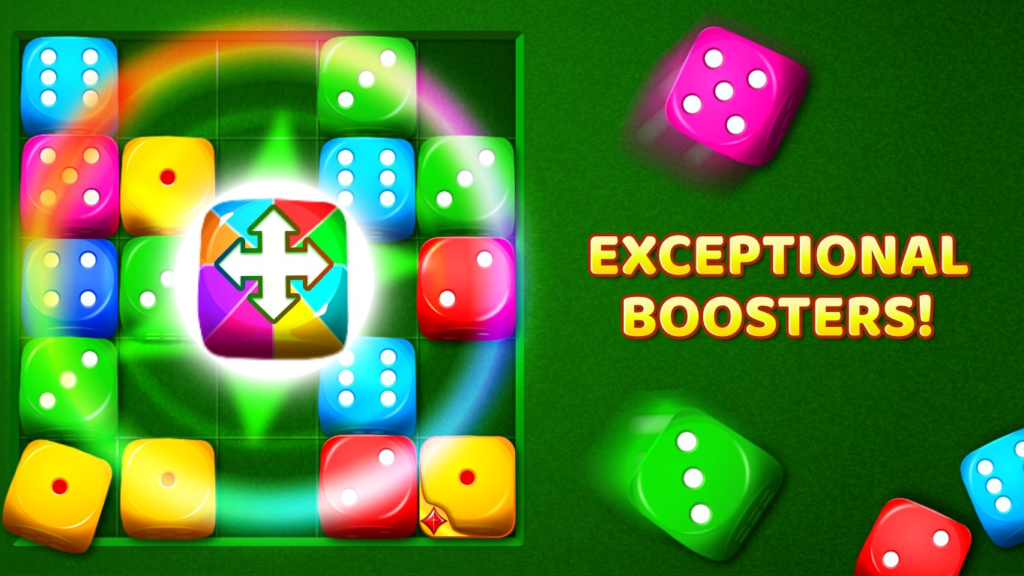
Storage Slots
The game includes storage slots (usually 1 to 3 slots, depending on the version). You can drag a die from the tray into a storage slot to save it for later. This is useful when:
- The current dice do not fit anywhere on the grid
- You want to save a useful die for a specific placement
- You need to cycle the tray to access a different die
Strategy tip: Use storage slots to hold dice that will be useful soon. Do not waste them on random dice you could place immediately.
Game Over Condition
The game ends when you have a die (or pair) in the tray that you cannot place anywhere on the grid. There is no space, or the shape does not fit any remaining empty cells. At that moment, your final score is displayed, and you can choose to start a new game.
There is no time limit. You can take as long as you want on each move. The only pressure is the gradually filling grid.
Scoring System: How to Maximize Your Points
While the exact scoring system may vary by version, the general principles are consistent:
Base merge points: Each merge earns points based on the value of the dice being merged. Merging three 1s into a 2 earns fewer points than merging three 5s into a 6. Higher-number merges are exponentially more valuable.
Chain merge bonus: When one placement triggers multiple merges, you receive a bonus. The longer the chain, the larger the bonus. A three-merge chain is worth much more than three separate single merges.
Board cleanliness bonus: Some versions award end-of-game bonuses based on how few dice remain on the grid. A nearly empty board earns a higher bonus than a nearly full board.
Key insight: Merging higher numbers is the most efficient way to score. A merge that creates a 6 is worth many times more than a merge that creates a 2. This encourages you to build up numbers rather than constantly clearing low-value dice.
Chain merge strategy: A single placement that triggers three merges is usually worth more than three separate placements that each trigger one merge. Look for opportunities to cause chain reactions. The game rewards thinking ahead.
Strategies for Beginners
If you are new to Dice Puzzle or merge games in general, these strategies will help you survive longer and score higher.
1. Keep the Grid as Empty as Possible
The more free space you have, the more options you have. Avoid filling the grid unnecessarily. When you have a choice between two placements, choose the one that leaves the grid more open. Empty space is your most valuable resource.
2. Plan for Diagonal Merges
Since diagonal connections count, do not ignore corners and diagonal adjacencies. Sometimes placing a die diagonally adjacent to two others creates a merge that would be impossible horizontally or vertically.
Example: If you have two dice of the same number diagonally adjacent to an empty cell, placing a die of that number in the empty cell completes a diagonal line of three and triggers a merge.
3. Use Pairs Strategically
Pairs take up multiple cells at once. Before placing a pair, visualize where both dice will go. Sometimes a pair can complete two separate merges simultaneously—one with the left die and one with the right die.
Tip: Rotate the pair before placing. The same pair shape rotated 90 or 180 degrees might fit much better or enable different merges.
4. Do Not Rush to Merge
Just because you can merge does not mean you should. Sometimes keeping three dice separate allows you to merge them with additional dice later for a larger merge (four or five dice at once). Larger merges often give bonus points and clear more space.
5. Use Storage Slots for “Problem” Dice
If a die in the tray does not fit anywhere, move it to a storage slot immediately. This cycles the tray and gives you a new die to work with. Do not waste time trying to force a placement that does not work. The storage slot exists to solve exactly this problem.
6. Focus on One Corner at a Time
Trying to manage the entire grid at once is overwhelming, especially for beginners. Focus on one corner of the grid. Keep that corner organized and relatively empty. Expand outward as needed. This “divide and conquer” approach reduces cognitive load.
7. Learn the Pair Shapes
Pairs come in a few standard shapes. Memorize them so you can visualize placements faster:
- 2×1 horizontal – Two dice side by side
- 2×1 vertical – Two dice stacked
- L-shape – Two dice at right angles (occupies a 2×2 corner)
- 2×2 block – Four dice (less common, appears in some versions)
8. Watch for Chain Merge Opportunities
Before placing a die, ask yourself: “If I place this here and it merges, will that new die immediately merge with something else?” If yes, you have found a chain merge opportunity. Prioritize these placements over simple single merges.
9. Do Not Be Afraid to Start Over
The game is short. A typical game lasts 5 to 15 minutes. If you make a catastrophic placement early, just restart. There is no penalty, and starting fresh is often faster than trying to salvage a doomed board.
10. Practice Pattern Recognition
The more you play, the faster you will recognize patterns. You will start to see opportunities automatically: “If I put a 4 there, then later when I get a 4 here, they will merge diagonally.” This pattern recognition is the skill ceiling of Dice Puzzle. The only way to develop it is through practice.
Advanced Strategies for Experienced Players
Once you have mastered the basics, these advanced techniques will help you push into high-score territory.
The “Waiting” Strategy
Sometimes the best move is not to merge but to wait. If you have two 5s on the board and a 5 in your tray, you could merge them into a 6 immediately. But if you wait, you might get another 5 later, allowing you to merge four 5s at once. Four 5s merging typically gives a higher score than three 5s merging, and it might also create a chain reaction.
When to wait: When the board has plenty of space and you are not under pressure.
When to merge now: When the board is filling up and you need the space immediately.
The “Corner Stack” Technique
Dice in corners are harder to merge because they have fewer adjacent cells (a corner die only touches up to three other dice). Use corners for dice you plan to keep long-term—high-value dice that are difficult to merge further. Save the center and edges for active merging where dice have more neighbors.
Pair Placement for Dual Merges
A single pair can sometimes trigger two separate merges at once. For example, placing a horizontal 2×1 pair so that the left die merges with two dice above it, and the right die merges with two dice below it. This clears four dice with one placement—very efficient.
Storage Slot Cycling
If you have multiple storage slots, you can cycle the tray continuously. Move the current die to a storage slot, which brings a new die into the tray. If that one is also bad, move it to another storage slot. This allows you to effectively “reroll” the tray until you get something useful.
Warning: This consumes storage slots. If you use all slots, you cannot save truly useful dice later. Use this technique sparingly.
The “Sacrifice” Move
Sometimes you have to place a die somewhere suboptimal to open up space. For example, placing a die that causes a small merge (clearing only a few cells) might allow you to then place a much more valuable die in the newly freed space. Do not be afraid to make sacrifice moves. A small merge now can enable a large merge later.
High-Value Die Management
Once you create a die of value 6 or higher, it becomes very difficult to merge further because you need three dice of that value to make the next number. High-value dice often end up as permanent space-takers. Try to keep them on the edges or corners where they do not block useful merges in the center.
The “Solo to Pair” Conversion
Some versions of Dice Puzzle include a mechanic where solo dice can be combined with pairs in specific ways. Experiment with dragging solo dice onto pairs to see if special rules apply. This varies by version, so test in your specific game.
Endgame Strategy
When the grid is 80 to 90 percent full, every placement matters. At this stage:
- Prioritize placements that clear space (merges). Clearing space is now more important than scoring points.
- Avoid placements that create isolated single dice. Isolated dice are very hard to merge later.
- Use storage slots aggressively. If the current die does not fit perfectly, store it and try the next one.
- Accept that some games are unwinnable. Even the best players lose eventually. The goal is to survive as long as possible.
Dice Puzzle vs. Other Merge Games
| Feature | Dice Puzzle | Threes! | 2048 | Merge Dragons |
|---|---|---|---|---|
| Core mechanic | Place dice, merge 3+ | Slide tiles, merge 3 | Slide tiles, merge 2 | Drag items, merge 3 |
| Diagonal merging | Yes | No | No | No |
| Pairs/tetrominoes | Yes (pairs, L-shapes) | No | No | No |
| Storage slots | Yes | No | No | No |
| Grid size | 5×5 or 6×6 | 4×4 | 4×4 | Expanding |
| Endless mode | Yes | No | No | Yes |
| Time pressure | No | No | No | No |
| Learning curve | Low | Moderate | Low | Moderate |
| Mobile compatible | Yes | Yes | Yes | Yes |
Dice Puzzle’s unique combination of diagonal merging and rotatable pairs sets it apart from other number merge games. It feels more like a spatial puzzle than a pure number puzzle. If you enjoy Threes! or 2048 but wish for more strategic placement decisions, Dice Puzzle is an excellent choice.
Who Is Dice Puzzle For? Audience and Suitability
| Player Type | Why They Will Enjoy It |
|---|---|
| Casual gamers | Short games, no time pressure, satisfying merges |
| Puzzle enthusiasts | Strategic depth, pattern recognition, optimization challenges |
| Number game fans | Familiar merge mechanics with a fresh twist |
| Kids (ages 7+) | Simple rules, colorful dice, no violence |
| Adults needing a mental break | Engaging but not stressful |
| Mobile players | Touch controls work perfectly; portrait orientation |
| Seniors | Cognitive exercise without time pressure |
Is It Suitable for Children?
Yes. Dice Puzzle contains no violence, no inappropriate content, and no reading requirements beyond basic number recognition. Children as young as 7 can understand the merging concept, though strategic thinking may take time to develop. The lack of time pressure makes it accessible for younger players who need extra thinking time.
Is It for Hardcore Gamers?
Not primarily. The basic version of Dice Puzzle has no leaderboards and no competitive elements. It is designed for relaxation and personal improvement. However, players who enjoy optimization and pattern recognition may find deep satisfaction in chasing high scores and mastering the game’s mechanics.
Accessibility Features
- Large, clearly numbered dice
- High-contrast colors (numbers are distinct from backgrounds)
- No time pressure
- Responsive touch and mouse controls
- Colorblind players can rely on numbers rather than colors (the numbers are the primary identifier)
Age Rating Considerations
- ESRB: Everyone (mild cartoon themes)
- PEGI: 3+ (suitable for all ages)
- No in-game chat, no user-generated content, no online interactions (in the basic embedded version)
Why Play Dice Puzzle in Your Browser?
Dice Puzzle offers several advantages as a browser-based game:
Instant Access
No download, no installation, no account creation. Click the link and start playing within seconds. This is perfect for trying the game before committing to anything.
Cross-Platform Compatibility
The game works on Windows, Mac, Chromebook, iOS, Android, and Linux. The same link works everywhere. You can play on your desktop at work, continue on your phone during your commute, and pick up on your tablet at home.
No Storage Space Required
The game runs entirely in your browser using HTML5 technology. It does not take up space on your hard drive or mobile device. Your device’s storage remains free for photos, documents, and other important files.
Completely Free
The full game is free to play. No in-app purchases are required to access any features or levels. There is no “premium” version that unlocks essential mechanics.
Ad-Supported but Fair
The embedded version may show short video ads, but these appear between games (not during active gameplay). You can typically close ads after 5 to 10 seconds. The ads support the developer and keep the game free for everyone.
Progress Does Not Need Saving
Since each game is a fresh session with a new random dice sequence, there is no long-term progress to save. This makes Dice Puzzle perfect for quick breaks. Play for 5 minutes, close the browser, and start fresh later without worrying about losing progress.
The Psychology of Dice Puzzle: Why It Is So Addictive
Dice Puzzle taps into several psychological principles that make it hard to put down.
The “One More Turn” Effect
Games are short—typically 5 to 15 minutes. When you lose, you immediately think, “If I had just placed that die one cell differently, I would have survived longer.” So you start another game. And another. The low time investment per game makes “one more try” very tempting.
The Pleasure of Merge
The visual and audio feedback of a merge—dice glowing, numbers increasing, chain reactions—triggers a small dopamine release in your brain. Your brain learns to associate merges with pleasure, so you seek more merges. This is the same psychological mechanism that makes slot machines addictive, but with skill-based gameplay instead of pure luck.
The Illusion of Control
Unlike pure luck games (slots, dice rolls), Dice Puzzle gives you meaningful choices. You feel responsible for your successes and failures. This sense of agency increases engagement. When you win, you feel smart. When you lose, you feel like you could have done better—so you try again.
The Pattern Recognition Loop
As you improve, you start seeing patterns automatically. This feels like mastery. The game constantly offers new puzzles to solve, keeping the pattern recognition loop active. There is always another configuration to optimize.
Low Frustration, High Satisfaction
Because games are short and restarting is instant, losses do not feel punishing. You simply start over. There is no “game over” screen that shames you, no lost progress, no penalties. This low barrier to retry keeps you playing through frustration rather than quitting.
The “Near Miss” Effect
When you lose with only one or two empty cells left, you feel like you almost won. Near misses are psychologically motivating—they encourage another attempt because success feels close. Dice Puzzle creates near misses constantly.
Frequently Asked Questions (FAQs)
1. Is Dice Puzzle really free to play?
Yes, Dice Puzzle is completely free. You can play the full game without spending any money. The embedded version may include occasional video ads, but these are brief (typically 5-10 seconds) and appear between games, not during active gameplay. No features are locked behind a paywall.
2. Do I need to download anything to play Dice Puzzle?
No download or installation is required. Dice Puzzle is an HTML5 browser game that runs directly in your web browser. Just click the link and start playing. The game works on desktop browsers (Chrome, Firefox, Edge, Safari) and mobile browsers (Chrome, Safari).
3. Can I play Dice Puzzle on my phone or tablet?
Yes. The game is fully compatible with iOS and Android mobile devices. It uses touch controls optimized for smaller screens. The default orientation is portrait, which fits well on phones. You do not need to install an app from an app store—just open the link in your mobile browser.
4. What is the highest number you can reach in Dice Puzzle?
Theoretically, there is no limit. In practice, most players reach numbers between 6 and 9 before the grid fills up. Extremely skilled players with lucky dice sequences might reach 10 or 11. Each merge requires three dice of the previous number, so the numbers grow exponentially harder to achieve. A 7 requires three 6s. An 8 requires three 7s (which themselves require nine 6s). The grid size becomes the limiting factor.
5. How does diagonal merging work?
In most merge games, only dice that are horizontally or vertically adjacent count for merging. In Dice Puzzle, dice that touch diagonally (corner to corner) also count. This means an L-shape, a zigzag pattern, or even a cluster of dice can trigger a merge. Diagonal merging greatly increases your placement options and rewards creative thinking. Always consider diagonal connections when scanning for merge opportunities.
6. Can I rotate a single die?
Single dice are symmetrical, so rotating them does nothing. Rotation is only useful for pairs (two dice connected together). Rotating a pair changes the shape—for example, a horizontal 2×1 pair becomes a vertical 2×1 pair after rotation. Use rotation to fit pairs into tight spaces or to position the two dice optimally for separate merges.
7. What is the best strategy for high scores?
There is no single winning formula, but the best players combine:
- Chain merges – One placement triggering multiple merges
- Board management – Keeping the grid open and avoiding isolated dice
- Storage usage – Holding useful dice for the right moment
- Diagonal awareness – Using diagonal connections to create merges
- High-value building – Prioritizing merges that increase numbers over low-value clears
Adapt your strategy to the dice you receive. Flexibility is key.
8. Is there an end to Dice Puzzle?
The game does not have a traditional “final level.” You play until you run out of space to place dice, then start a new game. Each game is a fresh session with a new random dice sequence. The challenge is to survive longer and achieve a higher score than your previous attempt. There is no “beating” the game—only improving.
9. Does Dice Puzzle require internet to play?
Yes, the browser version requires an internet connection to load the game initially. Once loaded, a stable connection is needed for ad serving (in the ad-supported version). If you lose connection during play, the game may freeze or fail to save your score. For uninterrupted play, ensure you have a reliable internet connection.
10. Can I save my game and resume later?
Because each game is a fresh session with no persistent levels, there is typically no save feature. You play until you lose, then start a new game. Some versions may pause if you switch browser tabs, but closing the browser will end the session. This design choice makes Dice Puzzle ideal for short, focused play sessions.
11. What happens when I merge four or five dice at once?
Merging more than three dice at once typically awards bonus points. The exact bonus varies by version, but the general rule is: larger merges = larger rewards. Some versions also create a higher-value die from larger merges—for example, merging four 3s might create a 5 directly (skipping 4). Experiment in your version to see the exact behavior.
12. Is there a penalty for bad placements?
No penalty other than lost opportunity. If you place a die poorly, you cannot move it. The only consequences are that you have one fewer empty cell and one more die that may be hard to merge. The game does not subtract points or punish you directly. However, a bad placement early can snowball into an early game over later.
13. Can I play Dice Puzzle with a keyboard?
Most browser versions are designed for mouse or touch. Keyboard controls are uncommon. Check the specific version you are playing; some may have number keys for selecting dice, but do not rely on it. For the best experience, use a mouse on desktop or your finger on mobile.
14. What is the best way to improve at Dice Puzzle?
Practice, practice, practice. Each game takes only a few minutes, so you can play many games in an hour. After each game, think about one or two moves that you regret. What could you have done differently? Over time, you will develop intuition for optimal placements. Also, watch experienced players if possible (videos or in person) to see strategies you had not considered.
15. Is there a multiplayer or versus mode?
The standard version of Dice Puzzle is single-player only. Some adaptations may include leaderboards comparing high scores, but you are not competing directly against other players in real time. The focus is on personal improvement and relaxation, not competition.
16. Why do some dice have different colors?
Colors are used to distinguish numbers at a glance. For example, 1 dice might be white, 2 dice light blue, 3 dice green, 4 dice yellow, 5 dice orange, 6 dice red. This helps you scan the board quickly without reading every number. Colorblind players can ignore colors and focus on the numbers (which are prominently displayed).
17. What does “solo or in pairs” mean in the game description?
“Solo” means a single die appears in the tray. “Pairs” means two dice connected together (like a domino). Pairs take up two adjacent cells on the grid. You can rotate pairs before placing them. Pairs cannot be separated; both dice must be placed together in the same move. Pairs add a spatial puzzle element to the number merge mechanic.
18. How many storage slots does Dice Puzzle have?
The number of storage slots varies by version. Common configurations include 1 slot, 2 slots, or 3 slots. Some versions have no storage slots at all (the tray simply cycles when you place a die). Check your specific version. More storage slots give you more strategic flexibility because you can save more dice for later.
19. Is there a way to undo a move?
Most versions of Dice Puzzle do not include an undo feature. Once you place a die, it is permanent. This is intentional—the game tests your planning skills and punishes impulsiveness. Think carefully before each placement. If you are unsure, take a few extra seconds to visualize the outcome.
20. Does Dice Puzzle work on Chromebooks?
Yes. Chromebooks run Android apps and can also run browser-based HTML5 games. Dice Puzzle works perfectly in the Chrome browser on Chromebooks. No special configuration is needed. Just open the link and start playing.
21. What is a chain merge?
A chain merge occurs when one placement triggers a merge, and that merge creates a new die that immediately triggers another merge (and possibly another, and another). Chain merges are the key to high scores because they clear multiple dice with one move and often create higher-value dice faster. Look for opportunities to place dice that will cause cascading merges.
22. Can I play Dice Puzzle on an iPad?
Yes. The game works perfectly on iPad using Safari or Chrome. The touch controls are responsive, and the portrait orientation fits the iPad screen well. You can play with your finger or an Apple Pencil for precise placement.
23. How do I know when I am about to lose?
The game ends when you have a die (or pair) in the tray that you cannot place anywhere on the grid. You will usually see this coming: the grid will be almost full, with only a few empty cells scattered in patterns that do not match the shape of your current dice. When you are down to 2-3 empty cells, every placement becomes critical.
24. Is there a difference between the mobile and desktop versions?
The core gameplay is identical. The main differences are:
- Controls: Mouse on desktop, touch on mobile
- Screen size: Desktop offers a larger view; mobile may require scrolling
- Ads: Some versions show different ad formats on different platforms
The gameplay mechanics, grid size, and dice behavior are the same.
25. Does Dice Puzzle have sound effects?
Most browser versions include sound effects for placing dice and merging (clicks, pops, chimes). You can usually mute the game using your browser’s tab mute feature or your device’s volume controls. Sound effects are optional and do not affect gameplay.
The Cognitive Benefits of Playing Dice Puzzle
Beyond entertainment, Dice Puzzle offers genuine cognitive benefits:
Working memory improvement: Keeping track of where each number is located on the grid exercises your short-term memory. You need to remember “there is a 4 in the top-left corner” while scanning for other 4s.
Spatial reasoning: Visualizing how pairs and L-shapes will fit into the grid improves spatial intelligence. This skill transfers to real-world tasks like packing, arranging furniture, or reading maps.
Pattern recognition: The game trains your brain to recognize number clusters and merge opportunities quickly. This pattern recognition ability applies to many problem-solving contexts.
Executive function: Planning multiple moves ahead, inhibiting impulsive placements, and switching strategies when needed are all executive function skills. Dice Puzzle provides a low-stakes environment to practice these skills.
Stress reduction: The lack of time pressure, combined with satisfying visual feedback, makes Dice Puzzle an effective stress management tool. A 10-minute session can lower cortisol levels and improve mood.
Conclusion: Roll, Place, Merge, Repeat
Dice Puzzle succeeds at something few games manage: it is simultaneously relaxing and engaging, simple to learn but deep enough to reward hundreds of hours of practice. The diagonal merging mechanic adds a fresh twist to the merge genre. The rotatable pairs and storage slots provide meaningful strategic choices. The lack of time pressure makes it accessible to players of all ages and skill levels.
Whether you have five minutes before a meeting or an hour to kill on a rainy afternoon, Dice Puzzle fits perfectly. No download required. No account needed. Just dice, a grid, and your own wits.
So take a deep breath. Look at the dice in your tray. Scan the grid. Plan your move. And when those three dice touch and merge into a glorious higher number, feel that small thrill of satisfaction.
Then do it again. And again. And again.
The perfect score is always just one more game away.